In a marriage should the husband be the primary decision maker or should he allow his wife to have an equal voice in making decisions?


One needs the final say on matters that impact both: the executive decision-maker. However, the executive decision-maker should listen to the other person carefully and possibly even go with the other person's ideas at times if they're judged to have the better idea for the family.
For example, say a husband wants to send their kid to private school and the wife wants to send their kid to public school. There's no practical compromise here unless we want to send the kid to both somehow which is probably worse than either option.
Still, whoever is the executive (primary) decision-maker between the two should carefully listen to the other and possibly even go with the other person's idea at the end.
The main responsibility the executive decision-maker has is to take full responsibility for that decision. They should do everything possible to pay the costs and suffer any negative consequences of that decision. That's the responsibility they have in exchange for the final authority.
So I'm mainly in favor of an executive decision-maker. Typically most married couples seem to fare better if that's the man. I am against 50-50 partnerships with no designated leader since I don't see how that can possibly work to resolve conflicts, like in the case I exemplified above about whether to send a child to public or private school. Someone has to have the final say on these matters or else there's no resolution.
I have even had people suggest to me that maybe a coin toss could resolve the conflict, or in the scenario above, even let the child vote and let the child ultimately decide. That does resolve the conflict but I think that's extremely sub-optimal because while we have the conflict resolution, we don't have someone with the designated responsibility to suffer the consequences of that decision.
The coin can't protect the family from the consequences of that decision. The child can't protect the family from the consequences of that decision.
So the ideal is to have a responsible leader who will not only resolve the conflict by making the executive decision but will protect the family from the consequences. If someone has to die, that executive decision-maker should be the one to die. That's what makes them worthy of having the final say and associated trust from everyone else with the final say is that they are going to be the ones to ultimately suffer for the decision they made for everyone if someone has to suffer.
@GuyAnswersGirls123 nice to listen before you do what you’re going to do
As I'm equally able to bear any consequences, so I don't see any reason to have a leader in my relationship. We both talk, negotiate, compromise and treat the relationship as ours. We both care and commit equally so have equal rights. The rest is the matter of maturity. But I by default choose mature partners, so, we've never faced any problems during decision making process. Mature people can admit "you are right" or "I see it equally good but last time we did it my way, do now is your turn".
@IslaTheWitch The way I see it is that with competent and very like-minded people in a team, the hierarchy should be so shallow to the point of nearly vanishing. If you'll forgive a nerdy analogy of Star Trek: TNG with Captain Picard:
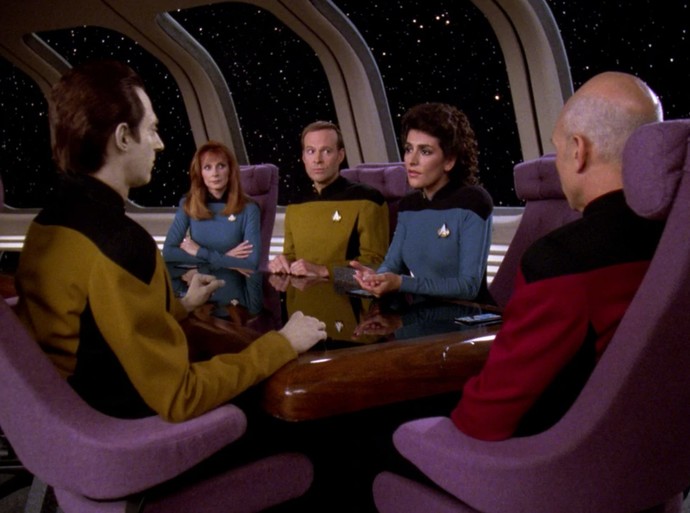
Every time a decision must be made that impacts the entire crew, Picard holds a council meeting with his senior officers to carefully listen to each one of their ideas and select what he deems best. Most commonly, it tends to be La Forge's idea with an engineering solution:
... with a dialogue like:
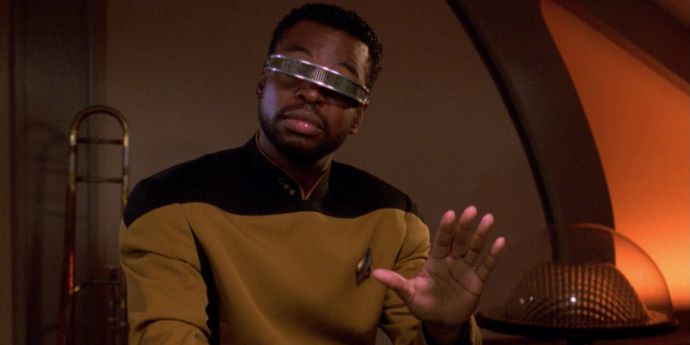
La Forge: Well, maybe we can do this with the engine. It might work. I'm not sure.
Picard: Make it so. You have N hours.
La Forge: That's going to be tight. We'll do our best.
Here Picard isn't transferring the responsibility over the ship and crew to La Forge even though it was La Forge's own idea he selected. He's keeping that ultimate responsibility. If La Forge's idea fails, you can imagine a hypothetical dialogue like:
La Forge: I'm so sorry that the idea didn't work, captain.
Picard: It's okay. I made the decision, not you. I bear full responsibility.
That's one of the really useful functions of a leader as I see it is that La Forge may have lacked confidence in executing his idea if he bore the ultimate responsibility over the entire ship and not just the engineers. Now get on the damn escape pod. It's an order. [Picard stays behind to go down with the ship while escorting everyone to safety].
@IslaTheWitch Picard also doesn't micro-manage. He doesn't try to run the medical facilities; Beverly Crusher is in charge of that. He doesn't try to run the engineering bay; La Forge is in charge of that. And so forth. Also when Picard is seriously injured or sick, he's no longer acting captain and someone replaces him (Riker, e. g.), and then as patient in the medical facilities, it is Beverly or Dr. Pulaski in charge over him with the doctor/patient hierarchy: "Doctor's orders." Picard: "Yes ma'am."
So that might even bring into question why we need Picard in the first place. Every single one of his senior officers are competent leaders in their own right, and especially over later seasons, become suitable to replace him as captain: Riker, Data, Crusher, Worf, La Forge, Troi, they're all competent leaders in their own right and are leaders over their departments, and they can often work as a team and resolve conflicts on their own.
The reason he still serves such a useful function as I see it is that:
1) His willingness to take ultimate responsibility allows all of his crew to function better. They don't have to shoulder the burden and worry over the entire ship together with him and can just concentrate on their areas of expertise and worry about themselves and the people they directly oversee. They can trust him to make the ultimate risk-assessments for the entire ship because he's willing to bear full responsibility over the risks/costs.
2) He still resolves the occasional conflict, however rare, that wouldn't be resolved without an acting captain.
@IslaTheWitch To bring this to a concrete example, one time a couple of my close friends were arguing over whether to go to night club A or night club B. I'm very conflict-averse and a peacekeeper type and hate to see my close friends fight so I offered a resolution:
"Hey, how about this? Let's go to night club A since it's closer but I'll pay for both of your cover fees. Sound good?" Then both were very happy, including the one who wanted to go to B with a response like, "Hell yeah! That's awesome!" and they were all very happy and I resolved the conflict as a temporary leader. Yet the only reason they all loved my idea is that I was willing to pay everyone's entry fee. If I just stepped in said, "Hey everyone, I've decided we're going to night club A," that would have likely gotten the response, "Who made you in charge?" So the conflict resolver often needs to be the one willing to absorb the bulk or entirety of the costs of the conflict-resolving decision they made to make everyone happy with him/her as the conflict resolver.

Splitting the costs 50-50 doesn't always resolve the conflict. That's why the conflict in the above scenario with the nightclub even existed is that you had two people unwilling to pay for the other one's idea. I functioned as leader there and resolved the conflict by absorbing the costs 100-0 on my end. Everyone is happy to go along with my decision for the entire group when I'm willing to pay the entirety of the cost.
@IslaTheWitch The biggest and most difficult conflicts, especially crises, are where I see the designated leader (not one to emerge spontaneously in every situation, but one that is the default acting leader if no one else has been assigned to lead the area in advance) is crucial. It could be the woman in my book if she's satisfied with the responsibilities; the only thing I'm deeply opposed to and don't think can work for the rest of our entire lives together are partnerships with no default leader.

Yet I do find in my everyday situations that it still streamlines away little inefficiencies left and right that my wife has trusted me to be that default leader. If I use the analogy of a doorway, my wife and I both tend to prioritize the other's interests above our own so we would be like:
Me: Ladies first.
Wife: No, husband first.
Me: No, wife first.
Wife: It would make me happy to see you go through the doorway first.
Me: It would make me unhappy to go first.
Wife: What if we try to go at the same time?
Me: Okay. On 3! 3... 2... 1 [start going]. Wait, why didn't you go?
Wife: I thought it was 3...2...1... then go, not go on 1.
Me: Okay, let's do it that way. 3...2...1...
[We get jammed in the doorway].
So it helps that my wife lets me put her first.
Me: Ladies first.
[Wife goes through the doorway, I follow].
@IslaTheWitch One final thought on admitting who is "right", the majority of interpersonal conflicts aren't necessarily about right and wrong but deeply subjective conflicts.
It's not like an engineering conflict where we can all prototype solutions against a performance/unit/integration-testing benchmark and go with the person with the best prototype who solves the problem in the least amount of execution time and/or memory (I do favor this meritocratic, competitive solution whenever possible as it's the closest to objective resolutions).
The ideal prescription after a doctor accurately diagnoses a patient still tends to be deeply subjective since one treatment might have high success rates but a slew of side effects, the other lower success rates but fewer side effects, the other a 20% chance of fatality but those who endure it have almost no side effects, etc.
Since the patient absorbs all the costs, it should be up to the patient to decide what treatment option is best for them instead of the doctor. Yet imagine a case where the doctor can actually alleviate all the costs away from the patient. All the side effects are endured by the doctor and not the patient. If there's a risk of fatality, the doctor dies and not the patient.
That'd be awesome! I'd be able to choose the riskiest, costliest treatment option every time since I don't endure much/any of the risks/costs. Yet that's actually in large part what a leader is doing. He's letting people make decisions without suffering the costs. That's the most benevolent and generous way for a person to be to optimize everyone's well-being.
That can't always be divided so well, like let's say the side effects are split between the doctor and patient, or if there's a fatality, both the patient and doctor die together. That's the least optimal and most conflict-prone solution between the doctor absorbing the bulk of the costs vs. the patient absorbing the bulk of the costs vs. the two sharing the costs.
[*] That'd be awesome! [Doctors would] be able to choose the riskiest, costliest treatment option every time since the [patient doesn't] endure much/any of the risks/costs. Yet that's actually in large part what a leader is doing. He's letting people [avoid suffering costs by making decisions for them].
At the fundament of this philosophy of mine is that those who endure the greatest costs should be the ones in charge of a decision. When we start with that foundation and try to find a way to optimally resolve conflicts as soon as they emerge, we start working towards the selfless default leader (not always leader but the leader when no one has been designated to be one) concept to ease conflicts and optimize everyone else's well-being.
I know Star Trek; it's a beautiful utopia. Also, it's work, not a partnership.
Your examples are nice but lack maturity, so yes, a leader is needed. As I said, I choose MATURE partners so none of us crave being the leader, and we can put our pride aside and make decisions together as a team. There is also a matter of being a specialist in the area. I have mine areas of expertise he had his. In such we just notified each other of made decisions or taken actions or asked for required resources.
For mature partnership no leadership is needed.
@IslaTheWitch I could see that working and I wouldn't oppose it and especially if it works out in your case, I'm all about whatever works at the end of the day. I'd be a bit reluctant though to subscribe it to the masses if only because it might be difficult to find a couple so mature that they can divide not only the costs 50-50 but never blame each other for the other decision's.
It's especially equally splitting the blame part that I think requires the utmost most mature partners. Since one always ends up with the final say of, "Let's do this", whether it's just because that's what ended the conversation after much deliberation, or there's a turn-taking system, or anything else, it can be difficult if the person who took the turn isn't the one ultimately to blame for the decision.
So generally I think it's more palatable to our psychology at least if the person making the decision that impacts other people is the one that takes all the blame. That would still be compatible with taking turns (there's a much more extended thought on why I still favor the default leader when no one has been designated in advance, but I might need a MyTake since it's a rather bundled outlook) but for this part, I'm just a bit worried that splitting the blame might be a bit too difficult for most couples to consistently endure.
maturity and trust excludes blame. We take responsibility, we solve problems. But we don't blame each other. There are no turns. And in many cases the responsibility is on both partners, so both communicate and react. In partnership blame doesn't exist. We accept that not everything works as expected and work TOGETHER to fix it and make even better. And because we both commit equally we have twice much good and silly ideas to choose from.
@IslaTheWitch Well, if I use an example, my wife is extremely mature and I'm easily the less mature between us. We've never truly fought in 14 years of marriage but there was one time around 10 years ago when things got slightly heated between us.
She told me about a mutual friend's party about a week in advance and apparently I agreed to go, but I must have been distracted since I didn't hear it or it immediately slipped my mind. She came home on the night expecting me to be ready to go and I wasn't; I was in my boxers on the computer and not at all ready.
So understandably she was irritated but I also got irritated since I didn't even remember her telling me about it. I can only take her word for it that she told me but it's difficult to take blame for something I don't even remember in the slightest.
So I was rushing to get ready and she was becoming irritable and I was becoming irritable very uncharacteristically of us being into Stoicism on my end and Buddhism on hers. So I asked her, "What's the big deal anyway if we're a bit late? They're not even waiting for us to start the party. We can be fashionably late."
Then she explained to me that in Japan, it's considered incredibly rude to be late for a party, even one where no one has to attend on time. I didn't know that and was like, "Ohh!" I've been a bit Americanized over my stay in the US and didn't see it as that big of a deal.
So then I offered the solution: "Hey, no problem. I'll take all the blame for us being late and explain to everyone that you told me and that it was my fault." Then she cheered up immediately and I made some jokes and she laughed and we started hugging and getting frisky until I was like, "Oh wait, I better hurry up or we'll be really late!"
@IslaTheWitch Like that. It's a conflict resolution method to absorb the bulk of the costs/blame. I tried to do my best to absorb as much as possible and that's what cheered up my wife. If I wasn't willing and we had to divide the costs/blame, then that little conflict might have escalated from mild irritability to something genuinely angry and divisive.
In that case, I was probably the one being immature thinking my wife was at fault for not telling me in ways I could remember about the party. Yet my solution to resolve the tension was to absorb all the blame and costs for it. Our long-term solution was also to start marking all such events on our calendar. This way I can be reminded daily of upcoming events.
@IslaTheWitch How might that above scenario play out with you and your partner if I may ask? A concrete picture might help me to understand how it works to resolve conflicts, like say you told your partner the way my wife did and he forgot and wasn't ready.
I understand than in your relationship it works. In mine we rather used events in shared calendar, so no one could forget. I understand she was happy you will be blamed, for me nothing to be happy about. I'm rather into predicting problems and consequences, the same was my partner.
So my way would be take responsibility for creating calendar event and adjust reminders. Definitely less heated and more mature. At least from my perspective.
@IslaTheWitch I see; that sounds incredibly mature and responsible! In our case, I think we lacked that sort of designation in advance so we had to learn the hard way for the calendar's need with the cost absorption on my part to eliminate the conflict.
I tend to want to encourage that degree of accountability you possess in all human beings, men and women alike. I think at least idealistically, there would be no need for anyone to take accountability on another's behalf (at least not a grown adult) since everyone would take accountability for their side of the equation.
Where I tend to subscribe to the notion of "hyper-accountability" (willing to take blame even for potentially other people's actions) is more for what I deem to be practical reasons at least in my case. I might even be the one lacking enough maturity to do otherwise; it's easier for me to just step in and take ultimate accountability for others than to try to divide it up by taking control over the situation by making the executive decisions. It transfers all the blame to me and it's not the power I seek (the vast majority of the time, I just go with my wife's idea), but the blame and suffering. I want to be the one to suffer.
One of the things though just personally and not pushing this on others is that there is a kind of "masculine poetry" that speaks to me and inspires me that I should suffer and ultimately die on my wife's behalf whenever I can help it. I like it that way. A wife who suffers and ultimately dies on my behalf would grieve me deeply that I might never recover. It is where I derive the heart of my ethics is that I should be the one to suffer on my family's behalf if someone has to suffer, and it's easier for me to take on that associated suffering when I have this role.
lmao at "masculine poetry" I don't appreciate or accept such a thing :D
In general I'm a logical being focused on minimizing every day burdens to efficient minimum as I genuinely enjoy life. So I prefer have any possible fun than fight with side effects that can be easily predicted and taken care of.
@IslaTheWitch It resonated deeply with me ever since I was a boy. I always wondered to what degree it's associated with nature vs. nurture, since I most idealized stories of men giving their lives to save their families the most, and even more so than most other boys my age.
I think it might be the result of being biracial and kind of torn between cultures. At the end of a lot of conflicting cultural ideas of ethics, I might derived some just based on my own endocrinology. I was one of the most aggressive kids, for example, so I figured the noble way to be aggressive is to channel it to protect others. So I think that's where I derived the ultimate ethic of the protector is that my violent and aggressive tendencies seemed thoroughly unethical unless they were applied in the context of protecting other people, and so I came to admire a lot of stories of masculine figures who did that. I think I needed the ethics more than most since a lot of people don't tend to have violent and aggressive impulses to the same degree; I had a serious case of precocious puberty at around 7 years of age where I needed the strong ethical restrictions and ideals of what makes a decent man as opposed to a villainous one to avoid becoming a delinquent.
@IslaTheWitch But one of the things is that I'm very different from your traditionalist types and I'm allergic to this "tradwife" trend.
Since I see the ultimate noble act as a man giving his life to save his family, the most valuable wife to me has always been the one who has leadership qualities herself, can fend for herself, provide for herself, since I don't want her to be helpless when I am dead or unable to lead in any other way. In a similar way, I think a man should be able to do all the homemaking and cook and clean as well as his wife, e. g., with a strong overlap and blurring of traditional roles since I think that leaves everyone better suited to protect the family.
So I tend to cause some friction with both traditionalists and non-traditionalists with my thoughts. I'm extremely non-traditional with the actual division of labor and the types of wives I value most. Yet I am still traditional in the most minimalist sense that I believe I should die on behalf of my wife and not the other way around.
I would deeply admire a woman though who also thought it's her job to die on her family's behalf and not her man's. We'd probably be incompatible competing over this, but my ethics most idealize the selfless leader who sacrifices himself/herself on other people's behalf. That's exactly what gives them the right to lead as I see it is their willingness to shoulder the burdens and costs of their decisions away from others, including death as the ultimate cost.
for me it's a kind of cowardly way of navigating between events... yeah I will sacrifice myself and let the others, I suppose to love and care for, deal with the grief and consequences. Yeah... very noble...
@IslaTheWitch I see it like the exchange required to lead if we must hypothetically require a leader in some contexts. It's a bit dramatic and everyday situations aren't going to be dramatic but I see it like a "hierarchy of death".
Like a decent captain requires leadership skills like initiative, assertiveness, empathy, diplomacy, emotional maturity, social skills, etc, but I think the ultimate value that distinguishes him/her and makes them most fit or not to lead is that they accept being the ones with the lowest priority for the metaphorical escape pod. If there is room for all the crew to escape save one, it should be the captain left behind as I see it if he/she is most suited to be captain.
A problem I see these days is that the selfish leader is becoming more popular than the selfless one: the one who takes the lion's share even when their followers are starving, when I think it should be the leader that should starve if someone has to starve.
It's not the most logical view for sure and can be downright impractical at times. Yet I consider it, being atheist, in the realm of the arts and humanities. It helps me a lot to find a sense of meaning and purpose to my existence that goes beyond my well-being and my limited existence.
the difference is I don't treat my people as my workers. We make decisions. And we seek solutions to save everyone, not matter the cost. I don't like the heroic examples of a captain who leaves as the last the sinking ship. I also think captain's leadership skills are needed with the saved people to decrease possible next casualties.
There is always a solution. We just have to be alert and focused on finding it and not on being romantically brave...
We were fourteen, when my best friend got in trouble with mafia. We were together and of course the best fun for mafia lowest in hierarchy men is giving you impossible choices.
So my friend had to choose who gets a blind shot... him or me... he of course volunteered and I should watch it... nice? I would live the rest of my life with the image of him dying... great... how considerate of him...
you don't speak if not asked when the barrel touches your neck. But I did. they let me speak, they had fun. I offered being a tutor and babysitter for their kids. Stupid, right? It was all 14 years old could offer.
but you know, mafia is a closed environment. You can't easily enter it and you can never leave it. Having trusted person to take care of their kids was better deal than blind shot in kid's forehead.
Oh, I wasn't so smart back then, I was just looking for a solution... any solution... I didn't know how it worked. But I knew that there must be other solution than one of us dying.
@IslaTheWitch In my case, I don't see workers as workers when I was a lead engineer. I just saw them as colleagues. That actually was a problem in the past since I had difficulty delegating tasks and ended up trying to pick up after everyone's slack by doing everything for them.
On heroic sacrifice, I do think there is a selfishness to it in way as with your unfortunate situation. It's kind of like the concept that suicide is selfish; I do think there's some merit to the idea if we evaluate it by effects rather than intentions (I wouldn't assume a suicidal person has selfish intentions, but it does tend to impose costs on others).
But I do think with the mafia situation, it might have been easier to accept if your friend was the one to lead you into that situation. It would then make it easier to see that his sacrifice was noble if there was no way out of someone dying. Or if you led him into that situation, that you die. It's easier to accept someone having to die as I see it if someone brought us to where we are.
For example, if the metaphorical building is on fire, then I think I should lead my family to safety (including listening to my wife if she has any ideas on how to best do that) and be first to die. But if a firewoman shows up, then I think we should follow her. But also if she wants to be the last one out of the building or even die to save us, I won't contest it because she's our leader. I'll be very sad but also very grateful that she saved our family.
if you deliberately leave someone behind without even trying to find another solution, it is selfish AF
and ONLY effects matter in the end... the road to hell is paved with good intentions. A good intention means nothing if you don't consider the consequences others will have to bear.
And life is not for accepting the easiest ways but the best, most effective, and bringing the most gain. It means we put effort into situation analysis, we learn and draw conclusions. We don't let others take the lead if we see alternative solutions. It's our lives ffs, so let's live them consciously and get the most from them.
I don't believe in blame. So, I didn't see my friend as someone who led me into this situation. It was my choice to be there with him. I knew the area, and I knew it was dangerous. I was able to make my own decision and bear related consequences. And you still don't consider my emotional cost. His death would be the worst possible solution.
And in the building in a fire situation, I would probably take the lead because I feel directions without visual cues. And I would rather take a firewoman with us than let her sacrifice herself.
@IslaTheWitch Would you wish the same for your children if I may ask? That if there's a situation where you have an opportunity to save their lives by sacrificing yours, that they prevent you from doing so (possibly at the cost to their own lives), saying it was their choice to follow their mother into that situation, and not hers?
@IslaTheWitch Let's say the mother is in her 40s at least and the children are 25+. So they're adults as well. But there is this situation now where it seems like the only likely way after careful logical evaluation to save the group is for one to sacrifice themselves on everyone else's behalf.
I want them to be able to choose the best solution for them. How THEY feel it, not me. And it's something I taught them. To analyze and notice details, possible side effects, and consequences. But also calculate them and their feelings into the equation.
I want them to think independently and make the best decisions as they see them.
If I were to make the decision, then I would do EVERYTHING to save all of us because I know the emotional cost of losing someone. And I don't want them to experience it too soon. Also, I would let them voice their opinions.
And I'm not eager to sacrifice myself as I take care for my autistic daughter and can't freely give up my life, as I have RESPONSIBILITIES. So we would focus on saving everyone as we have no other choice.
I don't believe in situations in which someone has to die to let others live, it's not how it is in the real life. We often have to give up on things but not on life
@IslaTheWitch I'm not eager either to die. I neither want to die nor cause my wife to suffer from my death. I've tried to mitigate the costs imposed on her as much as I can with life insurance and my will but my death impose some cost on her as with the case of your daughter.
>> And I'm not eager to sacrifice myself as I take care for my autistic daughter and can't freely give up my life, as I have RESPONSIBILITIES.
What about your partner in this case? It seems to me like you have an excellent job in AI as a software dev, leadership qualities, accountability, and are more than capable of taking care of your daughter by yourself. What if he volunteers and your most careful and logical risk assessment evaluates that there's less than a 1% chance for your whole family to make it out alive without a sacrifice, but that his sacrifice could skyrocket this chance?
@IslaTheWitch If these scenarios are too dramatic (I do agree that they're very unlikely to ever occur), I might need to think up some more mundane ones. Yet the underlying principles are the same to me whether it's a mundane, everyday situation with very small costs involved for the participants, or the most extreme where the ultimate cost is death.
currently I'm facing my life alone and it won't change anytime soon.
but I see my partner as my closest family. And I would put the same effort as I do always, to keep him with us. Alive. I'm more like Kirk, I don't believe in lost cases.
@IslaTheWitch I have to admit that I think I'm most like Worf sometimes, not in the sense of being a tough Klingon warrior but just the kind of ethics that seem most natural to me as well as that pesky temper. 😅
I actually do lost causes to some degree as long as I'm one to suffer as much of the consequences as I can. I like the "poetic death". It's one of my peculiarities that I've had a difficulty squaring given my lack of belief in an afterlife (a lot of my ethics would be so much simpler to square if I believed in one).
so it's a biggest difference between us. You are open to sacrifice yourself even if it's not needed but it looks more poetic for you... I'm a robot. I do my math and set the algorithm to find the most efficient solution without loosing.
Maybe it's my disadvantage that I find nothing peotic in solving every day problems. Maybe I'm not romantic enough :D
but as long as I don't have to deal with any loss I don't care :D
@IslaTheWitch Big respect! 🤝 I am admittedly a bit of a hopeless romantic and that's something I often had difficulty working with other engineers. I'm a very extroverted, romantic, irrational one who loves metaphor and trying to find little pockets of meaning in everything. I'm the least logical on my team and the most emotional type.
That's my weakness though is the opposite if yours is a weakness. Mine definitely is a weakness as I can sometimes supersede what I think is a "poetic" or "beautiful" course of action to the most logical and practical one, even when a logical and practical one is most desperately needed.
we are different and it makes us interesting for each other :D
@IslaTheWitch I always enjoy our discussions if it wasn't clear despite our disagreements. Actually our discussions have been some of my favorite on this site as they have prompted me to reflect a lot. I like having my views challenged. 🤝
I think ultimately it sound be the man. That sound a real man will absolutely take his wife's feelings and opinions into consideration but there's never actually a true 50/50. It doesn't work. Someone in the end has to make the decisions and it's proven for thousands of years that men are better more sound decision makers for the most part.
A patriarchal society/household is a good thing. Before angry feminists attack me, yes there are exceptions as always and no I'm not saying places like Iran do it correctly. That is an extreme
@Nikki1989 no I actually did exceptionally well in history. Let's get into this please, tell me why you think a woman should lead?
Assuming my opinion was so dumb I'm sure you'll be about to find lots of examples where the woman was the clear leader who built our modern society right? Please list the women that rival the leadership of Napoleon Bonaparte, Julius Ceaser, Hannibal, George Washington etc
Opinion
30Opinion
Marriage is a partnership, and partnerships work together, including making decisions.
I think your update said it best. Sure, a couple is "team" in a sense, but it's not 50/50. I can tell you that I've seen many instances where (husbands typically) have the wrong idea that they need their wife's input on everything and because of that decisions are dragged out and reversed and changed indefinitely because women are very much typically emotional thinkers who have a difficult time making decisions except in certain matters. Women do have valuable input and perspectives on some things but 9 times out of 10 men need to nut up and make the decision otherwise nothing gets accomplished.
Well , one needs to lead , I agree it can't be 50/50 that would never work , but it depends on the skillsets too of the individuals involved.
For example , someone like myself , I'm an investment manager this is also my interest ( or one of them ) , I would always run financials , as this is what I'm into , I'd love to discuss that , but in all my time I've never found someone as interested as me , if I did that would be great.
In general , it should be the man , with input from his wife , but someone has to make the final decision or nothing happens , and in this area , things need to be moving forward.
It's a relationship, not a business, you dummy.
If you are in a relationship and "primary decision maker" is talked about. You done fucked up, and you best get your weak ass outta there before it ends up black and blue and waiting for a restraining order.
A relationship is only a relationship when there is communication, commitment and responsibilities. You cannot make any sort of decision without at least two of the three anyway. Hence you need to establish the platform before getting into any relationship.
This is why most "marriages" and "cohabit" relationships don't last. Everyone wants to be key decision maker, without knowing what the fuck a relationship is actually about.
This is dependent on the couple. I only have experience with 2 relationships and neither led to marriage.
In my first relationship, she was the more level-headed one who could see the big picture better. We never really discussed "who is in charge". We just naturally deferred to her judgement.
The opposite was the case in my second relationship. Again, we never really discussed "who is in charge". It was more that, when under pressure, she would crack and I had to step in or else the issue would drag out too long. She did not like this because she felt like I undermined her, but I only ever did so when time was of the essence and there was no reasonable expectation she could clear her head in time. If time allowed, I simply told her we will discuss the issue when we can clear our heads (mostly me meaning her to clear her head).
Someone has to be able to take the lead. Ideally it shouldn't be a matter of dominance, but there will always be situations when one person has to make the decision.
Sorry ladies, but 99% of the time that's going to be the husband simply because 99% of the time he's the one who primarily gets covered when the shit hits the fan...
equal say, work it out and work together to solutions. listen. might depend upon personalities and cultures.
What I try to do is get to a place where I can say "yes", most of the time, find agreement. It's not negotiation and it's not business. At least listen to her ideas and desires and understand them and find a way to get to a positive.
There's times I'll say..."not now", like with investment ideas and rarely do I give a hard "no".
equal is like 50 to 50 in u. s. senate. each veto each other. must have a way to tip... but can't go to court for a judge every argument daily.
the only possibility for decision making is one authority. so the solution is the thing i can't write.
It is never going to be a level playing field. Color schemes are typically more important to a wife than the husband. Spending decisions might be more important to the husband.
Rather than some theoretic framework couple decision is a more pragmatic cross product of many factors.
In Illiad (~1200 BC) one of the characters had to ask his wife's permission to give a gift. Couple decision making has never been as centralized as the question implies.
Well along to the bible there should be an open communication about the topic and afterwards they should decide together. If there is no good decision which both can agree to then the husband has to take the decision, but not to do an egoist decision but whats the best for the couple.
Leaving the husband to make all the decisions is a recipe for a total disaster. Men never think things through, they are NOT big thinkers.
This sort of thing should be 110% determined by what works for the INDIVIDUAL COUPLE. Anyone who says that all couples "SHOULD" work one way or another on this is completely full of shit, should be TOLD they are full of shit, and should be completely disregarded on this point and frankly on most issues.
No I think most successful marriages the decisions are made together where the knowledge of each is measured and compromise is used in the final decision.
I'm a firm believer in the woman being the sole decision maker at all times.
as they please. I prefer partner relationships
First, both must discuss, share their knowledge and experience about the things they have done in the past. Then they should make a decision. It doesn't matter 60/40, 80/20, 50/50 or 💯 % by husband.
Man is the head of his wife is what my Bible says
50/50 Nobody should have more say than the other.
This may be an unpopular opinion, but it is my strongly held belief that men and women are equal and that a marriage relationship should be a partnership.
To me it depends on who will benefit or use the decision the most. Say kitchen items or layouts or lawn mowers. Things like vacation homes and trips would entail some mutual agreements.
Luckily my wife and I agree on many things and decisions. Sometimes we talk and debate certain decisions. But they almost never turn into arguments. I would say it’s not 50/50 but very close and it works for us.
everyone should live their mariage however the fuck they please. not my buisness. i personally want a partner, not a pet i gotta order around.
They should certainly discuss any decisions regarding any major purchases and any decisions that would affect the both of them.
My wife is the boss. She knows it and I know i.
One needs to have the final word, but the person who disregards the concerns and input of the partner is an idiot
There is always a leader and a follower in any relationship, and that includes marriage. Having said that, female led relationships are rarely healthy or successful in the long run.
50/50. it's a team, not a one man decision.
Depends on the person, some people have poor judgement and decision making skills.
The wife should have a say in the matter but ultimately the husband has the last say in the matter.
She should be heard but he should make the ultimate decision
Decisions should discussed and agreed upon or a compromise agreed.
they gotta discuss it n decide together
@Kelly1 it’s a man’s DNA 🧬 to be Dominant
Why does the woman take the man's name?
Whatever the couple prefers
No ship has two Captains.
fortunately relationship is not a ship and partners are not a captain and his crew
I think it should be 50-50.
equal say
You can also add your opinion below!
Most Helpful Opinions