A hybrid uses gas too, just not as much as a normal gas engine. But they are also underpowered when running on gas. It's really just one more thing that can go wrong with it. Wait until the batteries catch fire and it reaches the gas tank.


A hybrid uses gas too, just not as much as a normal gas engine. But they are also underpowered when running on gas. It's really just one more thing that can go wrong with it. Wait until the batteries catch fire and it reaches the gas tank.


Hybrids are, generally, the worst of all worlds (if you exclude hydrogen cars, because those are just a sick joke). Hybrids have undersized engines that are pushed to their limits on a regular basis which means they wear out far faster than a typical gas engine, AND they have an electric drivetrain which means they have the weight of both and the complexity of both and at best, you get a bit more fuel economy. They're more expensive to make, but you also get a car that plummets in value, that no one wants to touch once it's 5 years old.
There ARE very NARROW applications where a hybrid might be the best choice, but that applies to relatively few people. The main reason hybrids exist is because of government interference - the government highly incentivizes their existence via their fuel mileage target requirements and the exemptions given to hybrids. On a level playing field, they wouldn't exist at all.
An EV would serve 85-90% of people's driving needs perfectly, but the infrastructure probably only supports about 60% of people, because that other 25-30% of people live somewhere they can't charge an EV at home - and charging at home is the single most important thing you need if you want to drive an EV. Most EV owners almost never need to charge using public infrastructure - only on rare occasions when they take long trips. But people who live in apartments or condos or other places where home EV charging isn't available or practical would have to completely rely on public charging, and while it's certainly possible, it's a whole lot less convenient, and is thus impractical.
This will change over time - we've already seen huge improvements, but the real improvement will begin next year, because starting in 2025, any new model car that's released will have the "Tesla plug" - i. e., the NACS (North American Charging Standard) plug - though it may take a few years before EXISTING EV models get updated. Regardless, in a couple of years, every new EV will have the same plug and will be able to charge at nearly every public charging facility, and that's going to change the game for new buyers. People with older EVs that aren't Teslas will need to use an adapter, which is somewhat less great, but still much better than today. Currently, non-Teslas use a completely different plug and billing system and can't charge at Tesla chargers, though Teslas can charge at non-Tesla chargers with an adapter. But Tesla's public charging infrastructure is widely acknowledged to be far easier and more reliable to use, which is why it's become the continental standard for North America.
There are maybe 10-15% of people who just wouldn't be well served with an EV today. Most of those would be larger, heavier trucks that do a lot of towing or other very heavy work and need to drive long distances. Those users will eventually be addressed, but today, being the exception and a much smaller market, it's not feasible to address their needs at large scale.
They have the same power when the petrol engine is running, because it's just charging the battery. The wheels are driven by electric motors.
The advantage is that you can re-fill a petrol tank faster than you can charge current batteries.

Wait, what?
yes. you don't have to wait in your car for it to charge again like electrics do. and you don't have to sit out in the middle of nowhere waiting for it to charge or run out of battery when on a road trip...
Gas is expensive but I still prefer them over electric or hybrids
Opinion
19Opinion
Not better just more versetile, espacially in areas where you can't charge a fully electric car as the infrastructure isn't there.
Its also the most fuel efficient car you can get.
So its a decent middle ground.
But car model plays a huge role as well. Unnecessary big cars are always bad.
If you have the ability to charge an EV at home. The price of electricity is reasonable. Your trips are under a hundred miles. One way. Less if you need HVAC. Than EVs are doable. Hybrids are better as an all around vehicle. But both, EVs and Hybrids have those dreaded lithium batteries that catch fire and burn forever! And cost a fortune to replace.
I hear the lithium mines aren't the most healthful places to work either.
We need new battery technology, but hybrids are brilliant. Some produce their own electricity through regenerative braking.
I have heard this also. To mine the rare earth minerals to make these batteries. You pretty much rape the earth while extracting the lithium.
I watched a documentary on Nicholas Tesla. He invented a lot of the technology that went into EVs. During the documentary. They said that the only way the world can become totally electric vehicles. Was to have wireless charging built into the highways. So you could charge while driving.
I heard it's like $13k to have EV charger installed in your home, at a minimum. And not sure I would want EV batteries exploding in my attached garage. Also the government can limit when you can charge your car anytime they feel like it. They will say too many people are drawing power and 'no power for you'. Most places don't have a lot of excess power available for everyone to be charging their cars.
@hahahmm Speaking from my own experience. I purchased my charge controller from a company in California. At the cost of around 800 dollars. FYI. The actual charger is built into my VW. My charging controller can be adjusted to a charging rate of 12 to 50 amps at 240 volts. My detached garage was already wired with a 200 amp, 240 volt service. So that was already in place. Which I wired the controller myself. Since we can do that in my area. Without having it installed and inspected by expensive contractors.
With my charger set at 12 amps. Which will fully recharge the car overnight. The utilities probably won’t know if I am using a heat pump, AC, or my clothes dryer.
FYI. My charger has a 30 foot cord to the car. So my car is a fair distance from any buildings.
I am sure installation prices will be different depending on where you live.
As I said. This was my experience.
Blood oath hybrids are better. Hired a Toyota hybrid when touring Western Australia. Pure electric was never going to work. (WA is larger than all but the 10 largest countries even though it is just an Australian state. Over 4 Texases in size).
Didn't lack power on gas at all and gave quite good fuel efficiency. Plus it was pretty quiet so I didn't get as tired. Next car will be hybrid for sure.
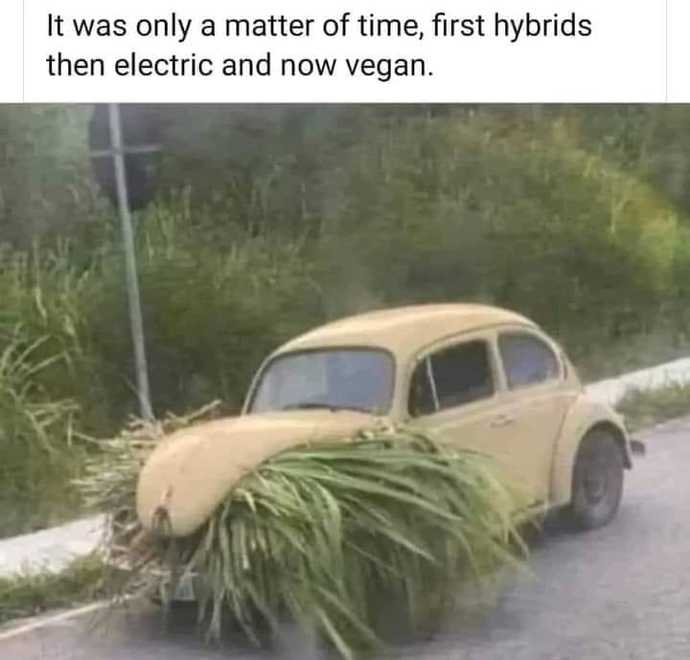
Love the vegan car pic - thanks.
I drive a hybrid a 2005 Toyota Prius I would say it's better than a full electric. The biggest reason is you don't have to plug it in and charge it so therefore it has a alternator that still charges the battery so it's self-sufficient as long as you have gas in it. So I'm not limited on how far I can go
The infastructure for charging isn’t quite as extensive in terms of chargeing stations and power grid capacity when compared to gas. I saw on the news there isn’t enough power generated for everyone to have electric cars. But for local trips if you can charging is good but long trips it’s more complicated. So hybrid is a good option. Charging a car even on the fast charging station takes 20 min but to fill up your tank is like 5 min. Time is also another factor
I guess its okay if you have a charger in your garage. But then you can relegate it to just local trips or grocery shopping. I would not take one on a cross-country trip.
It really depends on the model. Let's say you buy a Tesla Model 3 or Y, and you are going on a road trip. You leave with a fully charged battery, and you drive for 4 hours (we're assuming you're driving at 75-80 MPH). You stop at a fast charger, you get out, use the bathroom, grab some fast food, go back to the car, and you're already at over 80% charge (after 25 minutes of charging), which means you can drive another 3.5 hours without stopping. How often do you drive 8 hours or more in one direction?
Yes, if you really do go on drives of 20 hours each way, you're going to add a couple of extra hours for charging time - maybe you have to stop for 45 minutes every 4 hours to get a fuller charge - but most people will be stopping about that often anyway for food and bathroom breaks. And even then, most people don't drive like this all of the time - if they take such long trips at all, it's rarely more than once or twice a year. If you drive 20 hours each way on a regular basis, and you like to drive hard as much as possible with the absolute minimum stop times, than an EV is probably not the best choice.
Lol if you lucky. Enough to have a fast charging in ur garage great. Most residential house don’t have 440 volts because your beer fridge and garage opener can run on 110 which take 3 fucking days to fully charge. 220 for your hot toys takes 8 hours.
You are assuming that everyone arrives back home with a 0% battery, which is NOT the situation for the vast majority of people, just as most people aren't having to fill up a completely empty gas tank every day.
Normal home charging is a Level 2 outlet (220V), and as you say, that would take about 8 hours to fully recharge a battery from 0%, but in the real world, most people would rarely arrive home with less than 40% battery remaining. And for that reason, many *could* get by with Level 1 (110V) charging at home, though anyone who can should install a 220V outlet for those rare exceptions.
You aren't wrong about the worst case scenario, but that's just not the typical driving pattern for people in the real world.
Again, you are not wrong - that's the reality. But EV owners quickly get in the habit of plugging in whenever they get home, and it would be a rare event for most EV owners if they needed to do anything more than that - even with only 110V - unless they were road-tripping or something. Sure, there will always be the occasional exception where you might have to use a public fast-charger (like: you forgot to plug in and you rolled in at 18%), but if that's, say, 3 times a year, and you have to sit for 45 minutes each time (and you could go have a meal during that time), that's STILL far better than all the time you lose over a year filling up at gas stations, even if that's only 8-10 minutes each time.
But, hey, people run out of gas all the time too. With any car, things could go wrong, especially if you don't act in a responsible way - like plugging in or filling up. EVs just require changing some very minor habits - like plugging in whenever you arrive home. It's really not much of a burden - just a small adjustment.
I mean we are living in a world where semi solid state battery electric cars can go 600+ miles of range to 1200+ miles from tests happening right now.
One car drove in Japan for 6+ hours of non stop driving on highways/roads. So they are getting there to be more powerful than a gas powered vehicle.
Depends on where you are and how many chargers are in your proximity of driving.
EVs are getting more range and quicker charging…but if you’re asking, that means you should go with a hybrid.
People with enough money don’t need to ask.
nowadays... most cars are getting recalled by default
risk of fires everywhere...
You mean any car or just EV?
yes, any modern car... with ignition switches, airbags, and electric functions
they're so rushed and cheaply made... overlooked by quality engineering, and also bought/assembled in parts...
They're definitely more practical vehicles for most of the world. The reality is that most places don't have the infrastructure you'd need to support an electric vehicle.
Thankfully, the battery tech has improved massively, so we won't have the same environmental issues with EVs moving forward.
IMHO, any non-electric car will be better than an EV. I believe that EV's are deliberately being made to fail. The electric grid will never handle it. We need to get back to drilling that OIL
A hybrid has 2 power plants, Twice as much can go wrong and there are not many mechanics that can work on them.
@daniela1982
For once I think perhaps we should hand this one over for the guys to answer.
Toyota, the world's largest carmaker, has decided to emphasize hybrids over EVs. That should tell us something.
The only hybrid that is good is one that uses electric only and uses a generator to charge the batteries when they can’t be charged in time because there nothing around, like the Chevy volt
yes, if a storm puts out power, you can use gas. You get great MPG.
Best of both worlds.
Yes, they go longer distances. You can still drive the car even if the ev motor is dead… main differences. Gas is honestly the better option right now
Wait for the flying cars. I hear they're right around the corner.
Great! Next to the EV charging station they will have a runway. Unless you have one next to your office, you will still need transportation to it. It would be a nightmare for the FAA. I can envision a lot of mid air collisions or acts of air rage.
I'm sticking with gasoline.
You know that after they outlaw selling of new gasoline cars, the next step will be discontinuing the production of gasoline. Propane powered cars didn't make it as it costs more than gasoline.
The car manufacturers are pushing back on this because the electric cars are not working for people, and they're losing a ton of money. Car companies control politicians, not the other way around.
@thomastown But the prices of new cars are outrageous. A new Ford or Chevy PU truck can run $80,000. The Dodge TRX pickup with a Hellcat engine is like $120,000. That is the price of a house in some states.
Yes. Depending on where you live, access to charging stations can still be a challenge, especially over long distances.
They're actually worst
How worse?
they pollute more, the electricity part of the car don't have much lifetime and if the electricity battery is dead (need to get recharged) then the oil part of the car would consume a lot more than a traditional car. (I'm sorry if I explained myself badly I'm French and not good with car vocabulary, I'm not used to use it in English)
You did alright.
Really? That's weird, because we had electric cars at my old job and they were always complaining that they take like 6 hours to charge. My uncle in Poland had a hybrid and we did a week long trip to the mountains and didn't once stop at the gas station, so it seems more economical. When my other uncle took it out, he was driving on the gas the whole time, and we almost ran out in the middle of the woods
I don’t know the difference
cute. pic.
You can also add your opinion below!