 Girl's Behavior
  Guy's Behavior
  Flirting
  Dating
  Relationships
  Fashion & Beauty
  Health & Fitness
  Marriage & Weddings
  Shopping & Gifts
  Technology & Internet
  Break Up & Divorce
  Education & Career
  Entertainment & Arts
  Family & Friends
  Food & Beverage
  Hobbies & Leisure
  Other
Other  Religion & Spirituality
  Society & Politics
  Sports
  Travel
  Trending & News

Caveat: I am not a lawyer, although this post deals with discussions on the legality of US Citizenship.
On January 20, 2025, shortly after his inauguration as the 47th US President, Donald Trump issued an Executive Order concerning Birthright Citizenship.
The basics of the order state that a person born to a mother who is not a US citizen and is in the country illegally, is not entitled to citizenship unless the father is a citizen.
The complete text of the Executive Order may be found here:
PROTECTING THE MEANING AND VALUE OF AMERICAN CITIZENSHIP
This Executive Order has stirred controversy, with many pointing out that the 14th Amendment to the US Constitution automatically makes anyone born in the United States or its territories a legal US citizen. The Order has been shot down by a Federal judge as being unconstitutional.
But does birth automatically bestow citizenship?
PEOPLE BORN IN THE UNITED STATES WHO ARE NOT CITIZENS
There are some distinct cases where a person born in the United States is not a citizen of the United States.
Children of ambassadors and other foreign dignitaries who are born in the United States are not citizens of the United States.
People born and living in American Samoa, a US territory, are considered US nationals but not US citizens.
THE FOURTEENTH AMENDMENT
After the Civil War, slaves were freed by the Thirteenth Amendment. The Fourteenth Amendment granted citizenship to slaves and heir children, one of the main reasons for the passage of the amendment.
It is questionable whether the creators of the Fourteenth Amendment ever considered that it might be used to grant citizenship to those born here illegally.
ISSUES WITH BIRTHRIGHT CITIZENSHIP
There are some issues with birthright citizenship, when it is applied to illegal immigrants.
Under the existing system, if a mother enters the US illegally and then gives birth, her child is a US citizen. However, since she is in the US illegally, she can be deported, but her child (a US citizen) cannot. If she is deported, that separates mother from child, which is frowned upon, and typically means the mother is allowed to stay in the US as an illegal immigrant, essentially bypassing the law.
As the child gets older, the child is entitled to the benefits of citizenship, but the mother is not, creating some obvious social problems. For example, she cannot work legally, but has to somehow care for her child, which requires government assistance.
ISSUES WITH CHANGING BIRTHRIGHT CITIZENSHIP
Many people, including the 47th President, believe it's time for a change, to put some restrictions on birthright citizenship. That too, creates some issues.
Many Americans, those born in the US, unless they have a passport, have no documentary evidence of citizenship. A birth certificate just certifies that a person was born in the US, it says nothing about the legality of that birth, nor whether either parent was a legal US citizen.
If birthright citizenship is changed, then government agencies (ex: the State Dept and its issuance of US passports) will have to make additional checks; a valid birth certificate by itself is not enough, the status of the parent(s) must be validated. This may also require cities, counties and states that issue birth certificates to include the citizenship status of the parents. All of that involves additional time, effort and cost.
Or, the government might start issuing citizen ID cards, as is done in some other countries. That would be a major undertaking, frowned on by many, but could have additional benefits, being an easy way for a voter to prove their right to vote, and possibly replacing the need for a social security card.
OTHER COUNTRIES
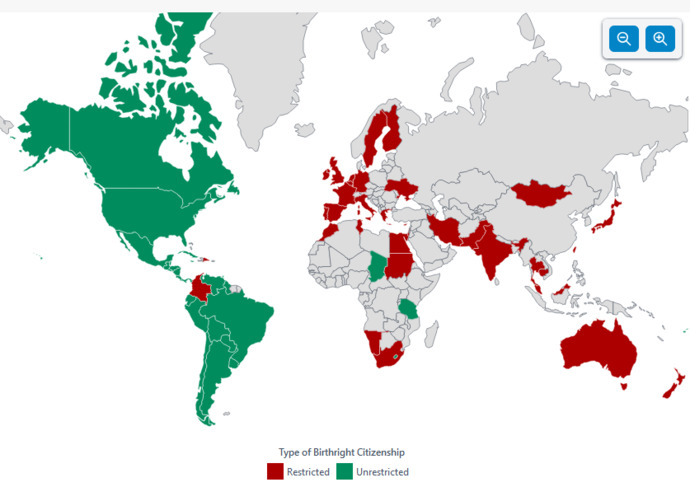
It's interesting that most countries do not automatically grant citizens to anyone born in the country, as shown on the map above.
Most countries require at least one of the parents to be a citizen in order for their child to be granted citizenship. Interestingly, almost all birthright-citizenship countries are in the Americas (North and South America), the result of colonization by European countries wishing to expand their populations.
IS IT TIME FOR A CHANGE?
Perhaps it is time to change birthright citizenship in the United States. Or maybe not.
At least one positive comes from Trump's Executive Order ... People are discussing the benefits, and issues, with birthright citizenship.


































Most Helpful Opinions